Project 08 of 09
Heat Transfer: Problem Design and Nodal Analysis
Programmatically designing a stable transient nodal model of a cooling aluminum extrusion.
- Context
- UC Berkeley · ME 109
- Role
- Programming design challenge
- Tags
- Heat transfer, Numerical methods, MATLAB
ME 109 Heat Transfer Programming Design Challenge
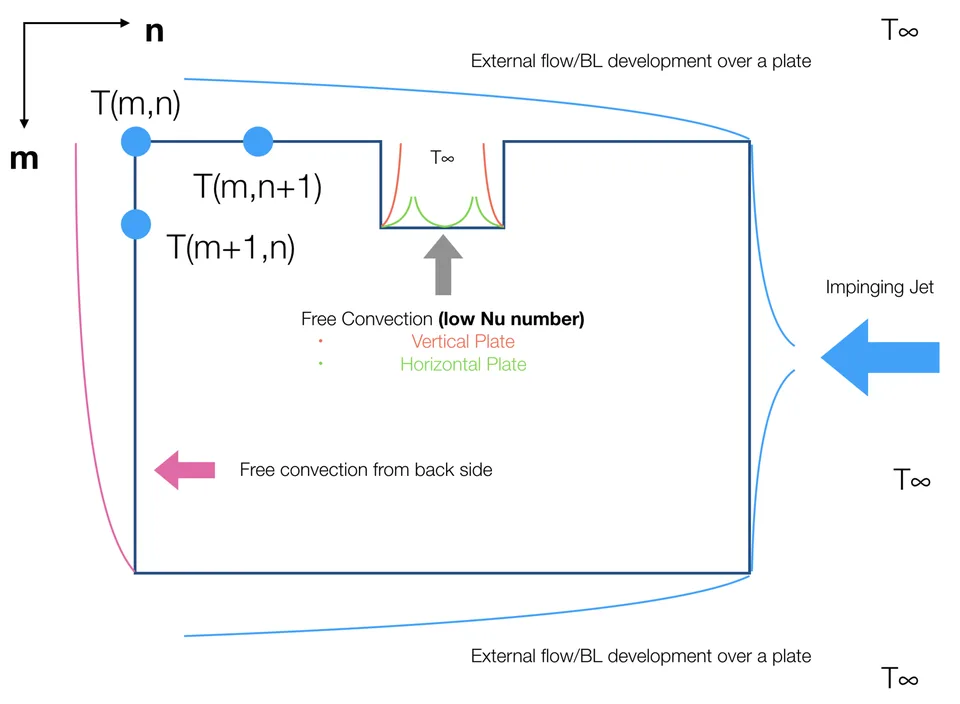
The task of this problem was to find the requisite cooling time of a long, hot (150C) aluminum extrusion, cooling in front of an impinging jet flow of air, which would ensure a maximum temperature of 20C within the part. Part of the challenge was to programmatically design a transient mesh of nodes on the part and establish appropriate boundary conditions (i.e. conduction, local heat transfer coefficients for laminar/turbulent free or forced convection, etc.) to "communicate" information of the heat transfer that was occurring through time.
Mathematically, however, transient heat transfer models of this type run a significant risk of instability (and thus, a failed simulation) if the designer naively chooses a node density and time step. Stability can be guaranteed by carefully devising energy balance equations for each individual type of node in the problem. For this problem, I found 17 unique nodes, meaning that regardless of how many nodes I wanted to pack in the part, I only had to come up with 17 equations. From these 17 equations, I found a time step and node density in x and y that satisfied the Fourier number constraints for all nodes. Lastly, I slapped a safety factor on the most stringent Fourier number constraint, and ran the simuluation. I found that the rod cooled in a whopping 430 seconds!
Check out below for more info, photos and code!